Español: https://noi.org/esp-minister-louis-farrakhan/
Biography Sketch: The Honorable Minister Louis Farrakhan: National Representative of The Honorable Elijah Muhammad and The Nation of Islam
The Nation of Islam under the leadership of the Honorable Minister Louis Farrakhan is the catalyst for the growth and development of Islam in America. Founded in 1930 by Master Fard Muhammad and led to prominence from 1934 to 1975 by the Honorable Elijah Muhammad, the Nation of Islam continues to positively impact the quality of life in America.
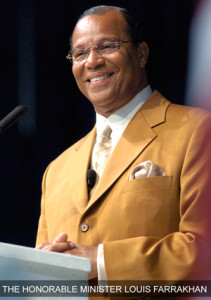
The Honorable Minister Louis Farrakhan, born on May 11, 1933 in Bronx, N.Y., was reared in a highly disciplined and spiritual household in Roxbury, Massachusetts. Raised by his mother, a native of St. Kitts, Louis and his brother Alvan learned early the value of work, responsibility and intellectual development. Having a strong sensitivity to the plight of Black people, his mother engaged her sons in conversations about the struggle for freedom, justice and equality. She also exposed them to progressive material such as the Crisis magazine, published by the NAACP.
Popularly known as “The Charmer,” Louis Eugene Walcott had achieved fame in Boston as a vocalist, calypso singer, dancer, and violinist. However, February 1955 marked a turning point in the life of the talented performer. While headlining a show in Chicago titled “Calypso Follies,” the young virtuoso received rave reviews. During this engagement, friends from Boston invited him to attend the Nation of Islam’s Saviour’s Day Convention at the newly purchased Muhammad Temple No. 2 at 5335 S. Greenwood Avenue in Chicago. Minister Malcolm X was informed that the popular musician would attend the convention. While listening to the Honorable Elijah Muhammad from his balcony seat, Louis thought to himself, “This man can’t speak,” referring to Mr. Muhammad’s grammar. As these thoughts crossed his mind, the Honorable Elijah Muhammad looked up at the balcony and said, “Don’t pay no attention to how I say it. Pay attention to what I say, then take it and put it into that fine language that you know.” Louis Walcott did not know that he had been given to the Honorable Elijah Muhammad by Allah as a Saviours’ Day gift to help in His great mission of giving life to millions of Black people in the United States and millions of oppressed people throughout the world.
Although music had been his first love, within three months after joining the Nation of Islam in 1955, Minister Malcolm X informed members of the New York Mosque and the new convert, Louis X, that the Honorable Elijah Muhammad wanted all Muslims to get out of show business or get out of the temple. Most musicians left Temple No. 7, but Louis X, later renamed Louis Farrakhan, chose to dedicate his life to the Teachings of the Honorable Elijah Muhammad. After moving to Boston at the request of Malcolm X, Louis X proved himself a capable, disciplined, and well-mannered soldier and eventually rose to the rank of minister. He worked faithfully from 1956 as the Minister of Muhammad Temple No. 11 in Boston, Massachusetts, building it to become one of the strongest temples in the Nation.
In May 1965, three months after the death of Malcolm X, the Honorable Elijah Muhammad appointed Minister Farrakhan to Temple No. 7 in New York City. When he arrived in New York, the atmosphere was very hostile because of allegations of Muslim involvement in the assassination. Minister Farrakhan worked night and day in the Harlem community and around New York restoring respect for the Nation. The departure of the Honorable Elijah Muhammad in 1975 and the assumption of leadership by Wallace D. Muhammad (later known as Imam W. Deen Mohammed) brought drastic changes to the Nation. After approximately three years of wrestling with the changes to the Teachings of the Honorable Elijah Muhammad, Minister Farrakhan, after a reappraisal of the condition of Black people and the program of the Honorable Elijah Muhammad, decided to return to the Teachings and program with a proven ability to uplift and reform his people. His tremendous success is evidenced by mosques and study groups in cities in America, Great Britain, the Caribbean and Ghana, all devoted to the Teachings of the Honorable Elijah Muhammad. Minister Farrakhan has renewed respect for the Honorable Elijah Muhammad, his Teachings, and program, in rebuilding the Nation.
Literally millions of listeners have attended his lectures and he has been welcomed in church after church, sharing pulpits with Christian ministers from a variety of denominations showing the power of the unity of those who believe in the One God. A devoted husband, father, grandfather, great-grandfather and great-great-grandfather, Minister Farrakhan still maintains a grueling work schedule. In 1979, he developed The Final Call, an internationally circulated newspaper that follows in the legacy of the Muhammad Speaks newspaper. In 1985, Minister Farrakhan introduced the P.O.W.E.R. (People Organized and Working for Economic Rebirth) concept and in 1986, introduced a line of personal care products and a program for Black economic development. In 1988, the resurgent Nation of Islam repurchased its former flagship mosque in Chicago and dedicated it as Mosque Maryam, the National Center for the Retraining and Re-education of the Black Man and Woman of America and the World. The National Center includes Muhammad University of Islam. In 1991, Minister Farrakhan reintroduced the Three-Year Economic Program to establish an economic base for the development of Blacks through business ventures. In 1992, Minister Farrakhan drew 60,000 people to the Georgia Dome in Atlanta for the Nation’s annual Saviours’ Day Convention.
In 1993, Minister Farrakhan observed his 60th birthday by performing Mendelssohn’s Violin Concerto with the New World Orchestra, including members of the Civic Orchestra of Chicago. In October of 1994, Minister Farrakhan led 2,000 Blacks from America to Accra, Ghana, for the Nation’s first International Saviours’ Day. The popular leader and the Nation of Islam had repurchased farmland in Georgia and enjoyed a banner year in 1995 with the opening of the $5 million Salaam Restaurant in Chicago and the successful Million Man March on Washington. Minister Farrakhan continued his quest for unity and progress by going on a World Friendship Tour of Africa, the Middle East and the Caribbean in early 1996. He was received by heads of state in 19 countries. As part of the major thrust for true political empowerment for the Black community, Minister Farrakhan reregistered to vote in June 1996 and formed a coalition of religious, civic and political organizations to represent the voice of the disenfranchised on the political landscape. In 1996, Minister Farrakhan was named among Time magazine’s list of the 25 Most Influential People in America; also, the National Newspaper Publishers’ Association, a group of Black publishers, honored The Minister as “Newsmaker of the Year.” In 1997, the Nation of Islam sponsored its first International Islamic Conference in July, receiving prominent Islamic leaders and scholars from across the globe. The spiritual significance of this conference was shown as prominent sheiks from Cyprus, Egypt, Yemen, Jordan and Nigeria on behalf of the 500 leaders and scholars in attendance at the conference placed a white turban on Minister Farrakhan’s head symbolizing the respect and honor held for Minister Farrakhan among those in the Muslim world. Vanity Fair highlighted Minister Farrakhan as one of “The 65 Leaders Who Rule and Shape the World.” At the end of 1997 into the beginning of 1998, Minister Farrakhan completed another world tour that took him to over 50 nations including, South Africa, the Sudan, Korea, Egypt, Libya, Russia, Malaysia, Palestine, Iraq, Iran, and Syria.
In 1999, Minister Farrakhan underwent radiation treatment for prostate cancer and spent most of 1999 on a sabbatical recovering. However, on December 22, joined by his family, ranking members of the Nation of Islam and religious leaders from the Muslim, Christian and Hebrew faiths at a press conference at Mosque Maryam, he spoke about being brought by Allah (God) to death’s door. “I have called this press conference today not necessarily to talk about my health or my near-death experience, but because the hope of the people of goodwill and righteousness is that the New Century and Millennium will bring an end to war and bloodshed and establish the reign of peace.”
In May of 2000, The Minister sat with “60 Minutes” Senior Correspondent Mike Wallace and the eldest daughter of Malcolm X, Sister Attallah Shabazz, in an interview shown worldwide in which Minister Farrakhan dealt honestly and forthrightly with the circumstances surrounding the assassination of her father. Though interviewed for over four hours, the 12 minutes of the interview that aired were edited in a very misleading way, completely misinterpreting Minister Farrakhan’s words. Coupled with a massive letter-writing campaign to the staff and producers of “60 Minutes,” Minister Farrakhan released the text of an interview conducted by The Final Call titled “Farrakhan Responds to Media Mischief” that set the record straight.
On the fifth anniversary of the Million Man March, October 16, 2000, hundreds of thousands of couples of all races and colors joined Minister Farrakhan on the National Mall in Washington, D.C., for a mass wedding ceremony and a show of unity with the goal of strengthening the family. The Million Family March was a success.
On September 16, 2001, Minister Farrakhan spoke out regarding the attacks on the Pentagon and the World Trade Center’s Twin Towers. On December 1, 2001, Minister Farrakhan wrote his first letter of guidance and counsel to President George W. Bush warning him of the mistakes of judgment being made in his ill-conceived “War on Terror.” On June 17, 2002, Minister Farrakhan announced that he would embark on a peace mission to the Middle East with a delegation of Muslim, Christian and Hebrew religious leaders in an effort to bring a new attitude and effort towards peace to this troubled part of the globe. On October 30, 2002, Minister Farrakhan wrote his second letter warning President George W. Bush of the Divine consequences of his course of action. On May 3, 2004, Minister Farrakhan in a press conference at the National Press Club in Washington, D.C., exposed the plans of President George W. Bush and the nefarious schemes of his neo-conservative advisors who plunged American soldiers into worldwide conflict. This international press conference was translated into Arabic, French and Spanish.
In 2005, Minister Farrakhan called those interested in establishing a programmatic thrust for Black people in America and oppressed people across the globe for the Millions More Movement. It was the 10th anniversary of the Million Man March. The Millions More Movement involved the formation of nine Ministries that would deal with the pressing needs of Black and poor people. Also in 2005, The Honorable Minister Louis Farrakhan was voted as BET.com’s “Person of The Year” beating out then-Senator Barack Obama, Oprah Winfrey and BET’s founder Robert Johnson, as the person users believed made “the most powerful impact on the Black community over the past year.”
In March of 2006, Minister Farrakhan led a delegation to Cuba to view the emergency preparedness system of the Cuban people, in the wake of the massive failure to prevent the loss of human life after Hurricane Katrina. In January 2007, The Minister underwent a major 14-hour operation. In just a few weeks, and as a testament to the healing power of God, Minister Farrakhan stood on stage at Ford Field in Detroit, Michigan, on February 25, 2007, during Saviours’ Day.
On October 19, 2008, Min. Farrakhan rededicated Mosque Maryam following extensive repairs as part of “A New Beginning” for the Nation of Islam and an expanded universal mission. In July 2009, Min. Farrakhan spent several days traveling throughout the Caribbean island of Bermuda. He addressed the spiritual, economic, social and political ills plaguing not only Bermuda’s residents but society as a whole. On March 20, 2010, Min. Farrakhan was a panelist during the “We Count!: The Black Agenda is the American Agenda” symposium held at Chicago State University. On June 26, 2010, Min. Farrakhan delivered the historic message answering a question asked by religious scholars and truth seekers for decades: “Who Are The Real Children of Israel?” In a message that was viewed live via webcast across the globe, Min. Farrakhan also announced the release of “The Secret Relationship Between Blacks and Jews,” Volume Two and “Jews Selling Blacks.”
Minister Farrakhan returned to Harlem on August 13, 2011, to deliver the keynote address at the Millions March in Harlem, where a crowd stretched for blocks down Malcolm X Boulevard. The gathering in the historic Mecca for Black culture and political thought was organized by the December 12th Movement to demand an end to the U.S.-NATO military assault on Libya, to denounce imperialist moves to recolonize Africa. “We must speak truth to power or die! We must not be afraid to tell the truth even if it means we lose our lives because there is nothing more precious in this universe than truth,” said Min. Farrakhan.
On Oct. 20, 2011, it was widely reported by national and international media that longtime Libyan leader Col. Muammar Gadhafi had been killed. Minister Farrakhan waited several days to speak publicly about the events transpiring in Libya and returned to the familiar setting of radio station WVON-AM in Chicago. Minister Farrakhan entered the studio October 25 with a focused and extremely serious look on his face as Mr. Cliff Kelley asked him how he was feeling. “I feel like I have lost a very, very important member of my own family. I can’t take the assassination of Muammar Gadhafi lightly, as I could not take the assassination of my brother, or my mother, or my wife or my children lightly. That’s the kind of relationship that we had and that we have,” Min. Farrakhan responded. “I’ve come to say to the world that the Nation of Islam mourns the loss of a great brother, leader, the Lion of the Desert, the Lion of Africa, and those who rejoice at his death, your laughter will turn to tears and your joy will turn to sorrow and great pain because of what the Western world and those collaborators will lose as a result of his betrayal and his ultimate assassination.”
The Minister continued his focus on developing the minds of the next generation of Black leaders and thinkers as he delivered messages to students on college campuses across the entire United States in 2012. He visited several Historically Black Colleges and Universities encouraging the students to “break free” from the educational system that has been set up by their oppressors to maintain control. His message was a precursor to the September 26, 2012 #AskFarrakhan Social Media Townhall Q&A which was webcast live from The Final Call Administration Building in Chicago, Illinois.
Minister Farrakhan was only in the state of Alabama for 24 hours, but in that short amount of time, history was made. He joined political leaders, community activists and members of the community under the banner of the “Never Forget, Never Again Pilgrimage” to save Section Five of the Voting Rights Act. It was a sweltering hot day June 14, 2013, with high levels of humidity and temperatures reaching into the mid-90s, but that did not matter. The spirit and legacy of the Freedom Riders of the civil rights era and modern demands to protect the Black right to vote were front and center during four back-to-back rallies. He also walked arm in arm with civil rights and political leaders in a walk across the historic Edmund Pettus Bridge.
In the summer of 2014, the Honorable Minister Louis Farrakhan was a featured guest speaker invited to open and close the Holy Month of Ramadan during the launch of the Ramadan “Tsunami” Prayer Line conference calls (now known as “Ramadan: The Ummah Reflects” podcast). And every year since, Minister Farrakhan has offered to the whole of the Muslim world guidance that unites The Ummah through the reconciling of our differences. The theme of uniting, along with raising the importance of the values of atonement, reconciliation and responsibility, The Nation of Islam traveled to the island-nation of Jamaica to observe the 19th anniversary of the Million Man March in the capital city of Kingston. Smiling as he looked over the crowd of thousands gathered at the National Arena, Minister Farrakhan said, “Jamaica, you are a pearl in the Caribbean. So much has come to the world from this island in the sun.” But the island in the sun and her smaller sister nations are not completely free and must unite in the face of efforts from America and Europe to control Jamaica, her land, her people and to keep the land and the region under their thumb, he said on October 19, 2014.
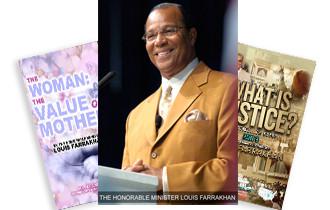
On April 18, 2015, The Minister, with a beaming smile, stood before a packed audience of women, teens and girls, and delivered an insightful message with the gentle protectiveness and loving firmness of a father, big brother and protector. He spoke on the value and importance of the woman as a co-creator with God who must be respected and protected in the face of injustices and abuses they face globally. He also explained the meaning and purpose of the all-women’s class established in the Nation of Islam called the Muslim Girls’ Training and General Civilization Class (M.G.T. and G.C.C.) and the value of the teachings of the Honorable Elijah Muhammad in rebuilding, educating and elevating in particular, the Black woman during the “Save Our Girls: A Nation Can Rise No Higher Than Its Woman” program which was broadcast via internet webcast in Nation of Islam mosques and study groups in the U.S., Caribbean, Europe and other countries.
Responding to the call of Minister Farrakhan, a virtual sea of determined faces, of different ages, races and ideologies gathered at the U.S. Capitol with their numbers swelling down the National Mall on October 10, 2015, for the Justice… Or Else! gathering marking the 20th anniversary of the historic Million Man March. To further the aims of this collective call for justice, Minister Farrakhan addressed a national conference call on November 15th themed “What’s Next?,” and gave insight on the impact an economic boycott would have on America. On November 16th, Minister Farrakhan delivered the message “Up With Jesus! Down With Santa! (Why We Are Calling You To Boycott Christmas)” to announce an economic withdrawal campaign during the holiday season.
In 2016, with the passing of Muslim boxing legend Muhammad Ali on June 3rd, the Honorable Minister Louis Farrakhan paid loving tribute to the greatness of his brother, a student of the Most Honorable Elijah Muhammad, during his June 12 message “The Life and Times of Muhammad Ali.” On August 5, 2017, those gathered at Kennington Park in London for the “Africa International Day of Action,” organized and co-sponsored by the Rastafari Movement UK and the Nation of Islam, were denied their right to view and listen to the Honorable Minister Louis Farrakhan’s message of healing and repair, “Reparations: What Does the UK and Europe Owe Us?” This gross violation of religious and free speech rights by Met Police and the Lambeth Council against UK citizens stemmed from the ban on Minister Farrakhan from visiting or speaking in the United Kingdom which has been upheld by the Home Office of the UK since the 1980s.
In November 2018, the Honorable Minister Louis Farrakhan led a delegation to visit the Islamic Republic of Iran, days before the Trump administration implemented brutal economic and other sanctions. During this trip, media uproar arose, falsely accusing Minister Farrakhan as having chanted disparaging words against the United States during his dialogue with students at Tehran University. To address this lie, Minister Farrakhan spoke to the media on Nov. 8 in Tehran at the offices of Press TV, Iran’s English language news and programming channel: “…I never led a chant calling for death to America. To say otherwise is a blatant falsehood and an attempt to paint me as an enemy in a very dangerous time as tension rises between America and Iran and nations around the earth reject unjust sanctions and heavy-handed U.S. foreign policy. I asked a question about how to pronounce the chant in Farsi during my meeting with Iranian students and an examination of the video shows just that. My point was to engage students in a talk about what gives a nation perpetuity versus that which undermines and destroys a nation. Evil, falsehood and violation of divine law doom nations to destruction, and the holy books of the world’s three greatest monotheistic religions warn us of such.”
In May 2019, social media platforms Facebook and Instagram banned, then removed, the Honorable Minister Louis Farrakhan’s account profiles, citing him as a “dangerous” voice. (Similarly, in January 2020, Twitter suspended and later reinstated his account.) In response, the “We Are Farrakhan!” social media protest was launched, and on May 9th, a community rally in support of Minister Farrakhan packed the sanctuary of St. Sabina Church in Chicago. “And here we are today… Some of us could not come out tonight because they did not wish to be censured by those who presently have power to censure. But that power is gradually being taken from you. And I am so grateful to God that He made me an instrument to bring that end of your wicked system of injustice,” stated Minister Farrakhan.
In June 2019, the Honorable Minister Louis Farrakhan, along with a delegation of 17, which included members of The Nation of Islam’s Shura Executive Council, visited the Holy Cities of Mecca and Madinah during the last 10 Days of the Holy Month of Ramadan.
Within the year 2020, Minister Farrakhan’s unequaled guidance and warning reached the world stage with the delivery of these timely messages: “Unraveling of a Great Nation,” delivered Saviours’ Day, February 23rd, in Detroit. Shortly thereafter, the U.S. and the world shut down as the COVID-19 virus paralyzed countries around the Earth. On July 4th, Minister Farrakhan delivered worldwide broadcast of “The Criterion,” in which he warned Black, Brown and Indigenous people against taking the COVID-19 so-called “vaccine.”
The Nation of Islam held its first-ever “virtual” Saviours’ Day conference February 26-28, 2021, as social distancing and lockdowns were still in effect in many parts of the country. The Minister addressed various current events of the time live via webcast during noteworthy plenary sessions, such as the virtual youth retreat “Defending Farrakhan,” and “COVID-19: The Virus and The Vaccine.” In 2022, The Minister delivered his Saviours’ Day message, “The Swan Song.” Later that year, in September, Minister Farrakhan addressed the M.G.T. and G.C.C. Vanguard during a special retreat; and in November, he addressed the F.O.I. The men and women of the Nation of Islam from around the country responded enthusiastically to the call from their leader, teacher and guide.
In 2023, Minister Farrakhan delivered the monumental Saviours’ Day message, “The War of Armageddon Has Begun” in front of an audience of thousands at Wintrust Arena in Chicago on February 26th. This year not only marked his 68 years of service in the mission and cause of the resurrection of the Black man and woman in America and the world, but a grateful Nation of Islam, along with friends and supporters, celebrated Minister Farrakhan’s 90th Birth Anniversary on May 11th, thereafter to be recognized as the Nation of Islam’s national “Day of Service.”
Organized by the Shura Executive Council, the Nation of Islam presented to Minister Farrakhan a celebration dinner and a profound love-offering on this day. However, it was The Minister who set the example for us all by being in service to the people for which he was born to be a helper to his teacher, the Most Honorable Elijah Muhammad: With help from meals prepared by the M.G.T. and distributed by the F.O.I., over 1,000 people in the community benefited from not only a hot meal, but sisterly and brotherly love.
On October 16, 2023, the Honorable Minister Louis Farrakhan and The Nation of Islam filed a lawsuit in the Federal Court of the Southern District of New York for 1st Amendment violations and for defamation against the Anti-Defamation League (ADL), Johnathan Greenblatt (ADL CEO/National Director), The Simon Wiesenthal Center (SWC), Rabbi Abraham Cooper (SWC Assoc. Dean/Director of Global Social Action). The Minister’s October 28th statement regarding why we filed can be viewed at https://noi.org/noivadl.
As wars and rumors of war continue to increase around the globe, and with the world watching the mass genocide of the Palestinian people at the barbarous hands of the State of Israel that is backed by American taxpayers, on February 25, 2024, the Honorable Minister Louis Farrakhan delivered the Saviours’ Day keynote address entitled “What Does Allah The Great Mahdi and The Great Messiah Have To Say About The War in The Middle East?” before a packed assembly at Huntington Place in Detroit, Michigan. The Minister called on The Muslim Ummah to be courageous, to stand up and speak out against these atrocities being carried out against their brethren. He also issued the warning to America and Israel, that “The Writing is On The Wall.”
A leader with unquestioned integrity, Minister Farrakhan is a protecting friend for those in need of a defender. Whether speaking out against the United States government’s military aggression abroad or working to end youth violence and police brutality in the inner-city, Minister Farrakhan continues to be a courageous and fearless voice speaking for the voiceless and empowering the powerless.